

Macao SAR Government Portal
News
UM signs MOU with the United Board for Christian Higher Education in Asia
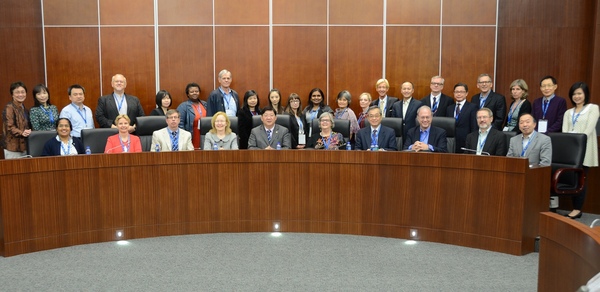
The University of Macau (UM) recently signed a Memorandum of Understanding (MOU) with the United Board for Christian Higher Education in Asia (UB) to enhance academic collaborations and the development of higher education in Asia. Under the MOU, UM and UB will explore the possibilities of joint PhD scholarships in selected fields for junior faculty members of Asian universities, collaborations in supporting initiatives at universities in mainland China and elsewhere in Asia to improve faculty teaching-learning practices, as well as other academic exchange programmes of mutual interest between UM and UB's partner institutions in Asia. The delegation, consisting of 23 trustees and staff of its New York and Hong Kong offices, were warmly received by UM Rector Wei Zhao, Vice Rectors Prof. Simon Ho and Prof. Haydn Chen, College Masters Prof. George Watt and Prof. Kevin Thompson, Honours College Dean Prof. Mok Kai Meng, Librarian Dr. Paul Poon, and Centre for Teaching and Learning Enhancement Director Prof. Spencer Benson. Prof. Simon Ho, Prof. Haydn Chen, and Prof. Benson told the guests about UM's latest developments, including the 4-in-1 mode of education, the general education programme, internationalisation strategies, research development, the residential college system, as well as teaching and learning initiatives. UB Board of Trustees Vice Chair Dr. Judith Berling, UB President Dr. Nancy Chapman, and UB Vice President for Programmes Dr. Glenn Shive shared the mission and vision of UB and its recent development with UM colleagues. The UB delegation toured the new campus after the meeting. They visited the new library and the various teaching facilities, saying that the new campus was very beautiful and well-planned.
…
Usage of Information Technology 2012
Information from the Statistics and Census Service (DSEC) indicated that the computer usage rate in the business sector was 51.0% in 2012, up by 4.1 percentage points year-on-year. Analysed by industry, the usage rate in Travel Agencies reached 98.0% while Services and Gaming had a rate of 80.8%; meanwhile, the usage rate in the Restaurant Sector increased by 3.2 percentage points year-on-year but remained low at 32.7%. The major purposes of using computers included word processing (72.5%) and databank (60.5%). Proportion of staff using computers was 45.0%, with the Hotel Sector having the highest proportion of 70.7%. Among the establishments and enterprises using computers, 82.6% had Internet connection, of which 84.0% connected via fixed line broadband, and the major purposes of using the Internet included information search (70.2%) and sending & receiving e-mail (69.3%). With regards to households, there were 156,400 households possessing information technology (IT) devices, accounting for 87.6% of the total, up by 2.7 percentage points year-on-year; the internet usage rate of households was 82.5%, up by 2.0 percentage points. For the population aged 3 and above, the rate of computer and Internet usage was 62.1% and 61.3%, up by 0.3 and 1.1 percentage points respectively year-on-year; those aged 15-24 had the highest rate of computer and Internet usage, at 93.9% and 91.4% respectively. With the popularity of mobile phones, proportion of population using mobile phone to access the Internet soared by 29.8 percentage points year-on-year to 63.5%. Among the Internet users, 86.9% used the Internet for searching information and 85.1% for communication; 81.5% of the Internet users went online everyday. Survey coverage of IT usage in the business sector includes establishments and enterprises engaging in Industrial Production; Construction; Wholesale & Retail Trade; Travel Agencies; Hotels; Restaurants; Transport, Storage & Communications; and Services & Gaming (Real Estate Management; Security Services; Cleaning Services; Gaming; Advertising, Conference/Exhibition Organising Services). Data on IT usage in households are collected from individuals aged 3 or above.
…
Direct Investment Statistics for 2012
Information from the Statistics and Census Service (DSEC) indicated that inward foreign direct investment (FDI) flows amounted to MOP 27.5 billion in 2012, up by MOP 21.6 billion year-on-year on account of foreign enterprises reinvesting part of their operating profits into the business. The majority of inflows were invested in the Gaming Sector (MOP 15.5 billion), Wholesale & Retail (MOP 4.5 billion) and Banks & Securities (MOP 3.9 billion). Analysed by investors' place of usual residence, FDI inflows came mainly from the British Virgin Islands (MOP 11.9 billion), the Cayman Islands (MOP 4.2 billion) and Hong Kong (MOP 3.8 billion). On the other hand, outward FDI flows from Macao enterprises amounted to MOP 3.6 billion, resulting in a net FDI inflow of MOP 23.8 billion in 2012. Inward FDI income earned by foreign investors totalled MOP 55.4 billion in 2012, up by 18% year-on-year, of which income earned from the Gaming Sector hit a record high of MOP 34.6 billion, accounting for 63% of the total; income from Wholesale & Retail (MOP 7.6 billion) and Banks & Securities (MOP 5.1 billion) shared 14% and 9% respectively. Meanwhile, Macao enterprises registered an income of MOP 0.9 billion from outward FDI, down by 26% year-on-year. At the end of 2012, stock of inward FDI reached MOP 151.3 billion, up by 27% year-on-year. Analysed by industry, stock of inward FDI in the Gaming Sector increased by 28% to MOP 87.6 billion, accounting for 58% of the total; stock of inward FDI in Banks & Securities (MOP 27.5 billion) and Wholesale & Retail (MOP 16.0 billion) rose by 21% and 45% respectively to share 18% and 11% of the total. Analysed by investors' place of usual residence, inward FDI stock was mainly financed by investors from the Cayman Islands (MOP 49.4 billion), Hong Kong (MOP 39.1 billion) and the British Virgin Islands (MOP 30.2 billion), up by 10%, 26% and 64% respectively. Meanwhile, stock of outward FDI of Macao enterprises amounted to MOP 9.3 billion in 2012, up by 75% year-on-year, with investment in Hong Kong rising by 5% to MOP 4.7 billion. Direct Investment Statistics provide an analysis of the FDI profile between Macao and other economies. For statistical purposes, Macao and Mainland China are considered as two separate economies. Coverage of Direct Investment Statistics includes the major industries of Macao, namely Industrial Production; Construction; Wholesale & Retail; Hotels & Restaurants; Transport, Storage & Communications; Financial Services; Gaming; and Cultural, Recreational & Other Services. In 2012, there are 2,115 inward FDI enterprises.
…
2014 Year of the Horse commemorative coins
The Monetary Authority of Macao (AMCM) will launch the Year of the Horse commemorative coins in January 2014 and will accept subscription for the coins starting from December 4 (Wednesday), 2013. To ensure the orderly conduct of the subscription process, AMCM will implement a quota system. From 7.30 am onwards on December 4 (Wednesday) at its office building (Calçada do Gaio, nº 24 e 26), AMCM will commence the distribution of fixed number of subscription passes to queuing subscribers who are holders of either permanent or non-permanent Macao resident identity card and each of them will be distributed only one pass while stock lasts. The pass-bearing subscribers should bring along their Macao resident identity card and come to AMCM to complete the subscription process in accordance with the date indicated on the passes. The maximum number of gold proof coins, 5 oz silver proof coins and the 1 oz silver proof coins that each subscriber can order is 2 pieces, 1 piece and 1 piece respectively and the commemorative coins will be allocated on a first-come-first-serve basis. On the other hand, the said commemorative coins will not be marketed by banks in Macao. For further details relating to the coins' selling price or subscription procedures, please refer to AMCM's webpage (www.amcm.gov.mo) or telephone 28565071.
…
The Embassy of P.R.C. in Thailand reminds Chinese citizens again to remain vigilant of security risk in Bangkok
In view of the renewed reminder by the Embassy of P.R.C. in Thailand for Chinese citizens to remain vigilant of security risks in Bangkok, Thailand, the Tourism Crisis Management Office (GGCT) reminds Macau residents in Bangkok and those who intend to visit Bangkok to remain vigilant, be aware of local security developments, carefully plan travel itineraries, elevate personal safety precautions and avoid getting close to the vicinities of demonstration areas. Following is the full translated text: Recently, the rallies in Thailand are spreading. Anti-government protesters are occupying a number of government departments and judiciary entities, also trying to breach barricades outside the police stations. TV stations and telecommunication providers have been invaded, causing electricity and telecommunications to be interfered. Cases of violence have occurred in Ramkamhaeng University on Novermber 30 and caused casualties. Anti-government protesters announced the organization of another larger scale demonstration on December 1. The Government authority in Thailand had strengthened local security in major areas. In view of the current situation, the Embassy of P.R.C. in Thailand reminds Chinese citizens in Bangkok and those who intend to visit Bangkok again to remain vigilant and aware of local security advice, plan travel itineraries carefully, avoid getting close to the vicinity of demonstration areas, try not to stay out during the night and take effective precautions to ensure personal safety. Red or yellow attire should be avoided, so as not to attract unnecessary problems. If in danger, please contact the Embassy of P.R.C. in Thailand, Tel: 00 66 854 833 327 (call in Thailand: 0854833327)." As per information collected from the Macao tourism industry, there are 4 Macao tour groups totaling around 40 pax currently traveling in Thailand. 6 Macao tour groups with an approximate total of 74 pax will depart to Thailand in the coming week. To date, GGCT has received 23 telephone inquiries but no requests for assistance. GGCT will continuously monitor the local situation. If necessary, Macao residents can call the 24-hour tourism hotline (853) 2833 3000 or the Embassy of P.R.C. in Thailand for assistance.
…
Decorations, Medals and Certificates of Merit List for 2013
(Macao—1 December 2013) In accordance to the nomination of the Decoration Awards Committee, the Macao Government announced the recipients of Decorations, Medal and Certificates of Merit to 40 individuals and entities in recognition of their outstanding achievements, contributions and distinguished services rendered to the Macao Special Administrative Region (MSAR). Decorations of Honour, including the Decoration of Honour - Grand Lotus, the Decoration of Honour - Golden Lotus and the Decoration of Honour - Silver Lotus, are awarded to individuals or entities that have made outstanding contributions to the image and reputation of the Macao SAR. The recipients are: Decoration of Honour – Grand Lotus
Mr Lau Cheok Va Decoration of Honour - Golden Lotus
Ms Ho Lai Cheng Decoration of Honour – Silver Lotus
Ms Lei Sio Iok
Mr Jia Rui Seven types of Medals of Merit are awarded for: 1. Professions; 2. Industry and commerce; 3. Tourism; 4. Education; 5. Culture; 6. Philanthropy; and 7. Sport. Each of these categories of decorations is awarded to individuals or entities that have make major or excellent contributions in their respective fields.
The recipients are: Medal of Merit – Professions
Mr Raimundo Arrais do Rosário
Mr Leong Keng Seng
Mr Lui Va Long Medal of Merit - Industry and Commerce
Mr Cheong Lok Tin
Mr Lei Chi Fong
Mr Si Tou Tek Lam Medal of Merit – Tourism
Macau Grand Prix Committee Mr António José Neves da Conceição Coelho Medal of Merit – Education
Mr Chan Chi Kwan
Ms Yip Wai Ming Evelyn
Mr Vong Kuoc Ieng
Ms Choi Sok I Medal of Merit – Culture Mr Dai Dingcheng
Yu Un Chinese Calligraphers and Painters Association of Macao
Portuguese Institute of the Orient
Medal of Merit – Philanthropy Ms Ung Pui Kun Medal of Merit - Sport Mr Lau Hong Meng
Mr Mak Chi Kun
Mr Choi Tat Meng Medals for Distinguished Services are awarded to public entities, organisations or their staff for outstanding performance of their duties or community service.
The recipients are: Medal for Distinguished Service - Medal for Dedication Department of Gardens and Green Areas of the Civic and Municipal Affairs Bureau
Ms Cheang Mui Leng
Mr Lam Wai Hou
Ms Wong I Lin Medal for Distinguished Service - Medal for Community Service Ms Maria Amélia da Conceição António Saldanha
Ms Lou Kan Sam
Mr Liang Baijin
Mr Sam Weng Kan Certificates of Merit including the Honorific Title - Prestige and the Honorific Title – Merit, commend Macao SAR residents or other people who have made major contribution to the reputation, development or social progress of the Macao SAR. The recipients are: Honorific Title – Merit
Mr Che Chon Seng
Mr Wong Ka Fai
Ms Tam Chih Wei
Mr Iao Chon In
Mr Chong Ka Seng
Mr Kuok Kin Hang
Ms Feng Xiao
Ms Liu Qing
Mr Cai Aolong The decorations, medals and certificates of merit awards ceremony will be held in the mid of December 2013.
…
Consumer Council released specific price survey results on 3 types of hygienic and cleansing products
For the implementation of Section 2b), Article 10, Law 4/95/M of 12th June, Consumer Council conducted its specific price surveys on personal hygiene products, household cleansing products, and shampoo & shower gels on 28th November. Results of the mentioned 3 surveys have been uploaded to the Council's website (www.consumer.gov.mo) and are available in the Council's 'Supermarket Price Information Platform' iPhone and Android apps. For inquiry, please call the Council's hotline: 8988 9315.
…
Carnival to be hosted at Iao Hon Market
A carnival and an exhibition featuring the services of 'Consumer Arbitration Centre' will be held by Consumer Council this Saturday (30th November) from 3PM to 5PM at Iao Hon Market. Citizens are welcome to participate in the event. Consumer Council continues to hold its carnivals and 'Consumer Arbitration Centre' exhibitions on Saturdays in November. This week, the Council will have another carnival held at Iao Hon Market from 3PM to 5PM. On-site quiz games, booth games and information about 'Consumer Arbitration Centre' will be exhibited during the event. For inquiry, please call 8988-9315.
…
External Merchandise Trade Statistics for October 2013
Information from the Statistics and Census Service (DSEC) indicated that total merchandise export for October 2013 amounted to MOP700 million, up by 10% year-on-year; value of re-exports (MOP533 million) and domestic exports (MOP167 million) rose by 13% and 1% respectively. Total merchandise import reached MOP7.15 billion, up by 23% year-on-year. Merchandise trade deficit amounted to MOP6.45 billion for October 2013. In the first ten months of 2013, total value of merchandise export increased by 9% year-on-year to MOP7.43 billion, of which value of re-exports (MOP5.76 billion) increased by 18%, but that of domestic exports (MOP1.67 billion) decreased by 13%. Total value of merchandise import grew by 13% to MOP65.70 billion. Merchandise trade deficit widened to MOP58.27 billion for the first ten months of 2013. Analysed by destination, merchandise export to Hong Kong (MOP3.92 billion) and Mainland China (MOP1.35 billion) in the first ten months of 2013 increased by 14% and 21% respectively year-on-year, while export to the USA (MOP302 million) and the EU (MOP230 million) decreased by 28% and 12% respectively. In addition, exports of Non-textiles (MOP6.71 billion) expanded by 14% year-on-year, of which exports of Electronic components (MOP847 million) and Diamond & diamond jewellery (MOP497 million) surged by 77% and 164% respectively. Exports of Textiles & garments (MOP717 million) decreased by 20%, of which exports of Knitted or crocheted garments (MOP244 million) declined by 28%. By country of origin, merchandise import from Mainland China (MOP21.43 billion) and the EU (MOP15.27 billion) increased by 14% and 12% respectively year-on-year in the first ten months of 2013. Imports of Consumer goods rose by 19% to MOP41.96 billion, with imports of Gold jewellery (MOP7.71 billion), Watches (MOP5.03 billion) and Beauty, cosmetic & skin-care products (MOP2.21 billion) increasing by 27%, 22% and 74% respectively. Imports of Construction materials (MOP2.23 billion) grew by 45%. External merchandise trade reached MOP73.13 billion in the first ten months of 2013, up by 13% compared with MOP64.71 billion a year earlier.
…
Results of Restaurants and Similar Establishments Survey 2012
Information from the Statistics and Census Service (DSEC) indicated that a total of 1,678 restaurants & similar establishments (1,626) as well as cooked-food stalls in markets (52) were operating in 2012, down by 36 year-on-year owing to a notable decrease in drinking places. Despite a decrease in number of establishments, total number of persons engaged increased by 4% year-on-year to 21,999. Receipts and Expenditure of the industry amounted to MOP 6.99 billion and MOP 6.31 billion, up by 15% and 11% respectively year-on-year. Gross Value Added that measures the sectoral contribution to the economy went up by 19% to MOP 2.80 billion. Gross Fixed Capital Formation dropped by 36% year-on-year to MOP 191 million on account of a significant decrease of 49% in that of restaurants. There were 1,626 restaurants & similar establishments operating in 2012. Number of persons engaged increased by 4% year-on-year to 21,900. Receipts of restaurants & similar establishments reached MOP 6.97 billion, up by 15% year-on-year. Analysed by type of industry, eating places (1,312) accounted for 81% of the total, and their Receipts soared by 23% year-on-year to MOP 4.21 billion; Receipts of restaurants amounted to MOP 2.46 billion, an increase of 8%. Expenditure of restaurants & similar establishments amounted to MOP 6.30 billion, up by 11% year-on-year. Major expenditure items included Purchase of Goods (MOP 2.60 billion) and Compensation of Employees (MOP 2.12 billion), both up by 11% year-on-year; Operating Expenses totalled MOP 1.58 billion, an increase of 10%. Analysed by type of industry, Expenditure of eating places reached MOP 3.79 billion (60% of total), and that of restaurants amounted to MOP 2.24 billion. Gross Value Added of restaurants & similar establishments rose by 19% year-on-year to MOP 2.80 billion; Gross Fixed Capital Formation decreased significantly by 36% to MOP 191 million. A total of 52 cooked-food stalls were operating in markets in 2012, down by 2 year-on-year. Number of persons engaged totalled 99. Receipts of cook-food stalls amounted to MOP 20 million, up marginally by 0.4%. Expenditure (MOP 11 million) and Gross Value Added (MOP 9 million) dropped by 8% and 2% respectively year-on-year. Coverage of the Restaurants & Similar Establishments Survey includes licensed restaurants, eating & drinking places and cooked-food stalls in municipal markets in 2012, excluding hotel-operated restaurants and similar facilities, as well as street hawkers.
…