

Macao SAR Government Portal
News
Ministers recognise importance of Sino-Portuguese Forum
The 4th Ministerial Conference of the Forum for Economic and Trade Cooperation between China and Portuguese-speaking Countries opened in Macao today with ministers representing participating countries addressing the gathering and highlighting the importance of the Forum. The Prime Minister of Guinea-Bissau, Mr Rui Duarte Barros, was the first to speak at today's Forum: he stressed that it was his country's goal to develop a true strategic partnership with China. Mr Barros added that Guinea-Bissau was doing its best to improve conditions for attracting and protecting Chinese private investors. The Vice President of Brazil, Mr Michel Temer, said the establishment in Macao of the Small and Medium-sized Enterprises Commercial Services Centre for Portuguese-speaking Countries was vital to achieving the goal of achieving US$160 billion in bilateral trade between China and Lusophone countries by 2016. Deputy Prime Minister of Portugal, Mr Paulo Portas, spoke highly of the work of the Forum, which demonstrated China's recognition of the global strategic significance of Portuguese-speaking countries. Mr Portas also underlined Macao's role as a bridge between the two sides, adding that the Cooperation and Development Fund between China and Portuguese-speaking Countries would serve as an important platform for spurring exchanges between enterprises on both sides. Deputy Prime Minister of Timor-Leste, Mr Fernando de Araújo, told the gathering that his country's current stability was attributed to the support of the global community as well as bilateral partners, highlighting the fact that Timor-Leste saw China as one of its most important strategic partner. The Minister of Justice and Human Rights of Angola, Mr Rui Mangueira, noted that as the Forum continued to grow in scale and scope, it had already become indispensable in economic exchanges among the participating countries. The Minister of Tourism, Industry and Energy of Cape Verde, Mr Humberto Santos de Brito, said his government had full confidence in the prospect of the Forum and he believed this innovative mechanism would help enhance the potential of every member country. For his part, the Minister of Foreign Affairs of Mozambique, Mr Oldemiro Balói, pointed out that his country had benefited greatly from the scholarships offered by Macao and China since the founding of the Forum. Mr Balói said the training provided to Mozambicans by Macao and China had improved the manpower of Mozambique and promoted the country's sustainable development.
…
The 4th Ministerial Conference of the Forum for Economic and Trade Cooperation between China and Portuguese-speaking Countries opens today
The 4th Ministerial Conference of the Forum for Economic and Trade Cooperation between China and Portuguese-speaking Countries opened today at the Macao East Asia Dome where the Chinese Vice Premier, Mr Wang Yang, delivered a keynote speech at the opening ceremony. The ceremony was presided by the Minister of Commerce of the People's Republic of China, Mr Gao Hucheng, who said that the Forum has been an important platform to deepen the mutually beneficial co-operation and development between China and the Portuguese-speaking Countries. He stressed that, under the theme of "New Starting Point, New Challenges", the 4th Forum would further boost the trade and business co-operation between China and the Portuguese-speaking Countries. Vice Premier Mr Wang reviewed the achievements of the Forum over the past decade and said actions have proved that China and the Portuguese-speaking Countries are partners in developments of mutual benefit. He said future co-operation between China and the Portuguese-speaking Countries would become broader and deeper, then announced the eight new measures to bolster co-operation. Prime Minister of Guinea-Bissau, Mr Rui Duarte Barros, the Vice President of Brazil, Mr Michel Temer, Deputy Prime Minister of Portugal, Mr Paulo Portas, Deputy Prime Minister of Timor-leste, the Minister of Justice and Human Rights of Angola, Mr Rui Mangueira.Mr Fernando de Araújo, the Minister of Tourism, Industry and Energy of Cape Verde, Mr Humberto Santos de Brito, and the Minister of Foreign Affairs of Mozambique, Mr Oldemiro Balói also delivered speeches. Some 980 guests at the ceremony included representatives from the Chinese Government, the Portuguese-speaking Countries, Hong Kong and Macao Affairs Office of the State Council, the Liaison Office of the Central People's Government in the Macao Special Administrative Region, members of the Executive Council, Legislative Assembly, business associations and entrepreneurs.
…
MGTO expands European market through exhibiting in UK
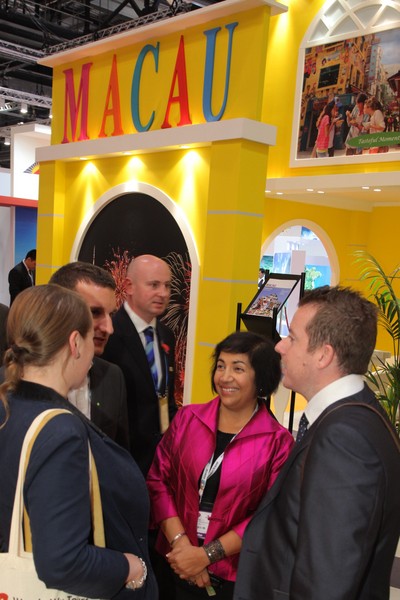
Macau Government Tourist Office (MGTO) is exhibiting at World Travel Market, an event inaugurated in London, the United Kingdom (UK) this week, to promote Macau's diverse tourism products, culinary delights and multi-destination tours. Through participation in the show, the Office aims to encourage more visitations from Europe to Macau. World Travel Market (WTM) is staged at the ExCel London exhibition centre from 4 – 7 November. The MGTO booth is located within the Asia section to showcase Macau's unique blend of East and West cultures under the theme "Touching Moments, Experience Macau". MGTO's Marketing Division and UK representative attend WTM 2013 among others. On the event's inauguration day, MGTO and Hong Kong Tourism Board (HKTB) again co-hosted an on-stand cocktail reception which featured special delicacies from both destinations. The invited guests include the acclaimed food writer and celebrity chef in the UK, Ching-He Huang, who returned lately from a culinary journey of discovery filmed in both Macau and Hong Kong. The event provides a great networking opportunity for travel trade professionals and members of the press to gather and learn more about Macau and Hong Kong in a relaxed ambience. It also serves as a chance to promote both cities' gourmet and multi-destination itineraries. MGTO is also unveiling a new "How to Sell Macau" guide in partnership with ABTA Magazine at WTM 2013. Introducing Macau's top ten experiences and one to three day itineraries in Macau along with practical travel tips, the guide helps UK trade to sell Macau more effectively. UK travel agents are also encouraged to visit the MGTO stand to learn more about the fascinating destination throughout the show. As one of the annual global events for the travel industry, World Travel Market welcomes close to 50,000 travel industry professionals this year. Capitalizing on the WTM platform, MGTO seeks not only to raise the destination's profile in the international travel industry but also to encourage more visits to Macau from the UK and European long-haul market. MGTO has always been dedicated to promoting Macau's attractions and positioning as a World Centre of Tourism and Leisure while striving to consolidate and expand the tourism market across the globe in order to promote diversity among visitors to Macau.
…
Vice Premier unveils 8 new measures to bolster co-operation between China and Portuguese-speaking Countries
Chinese Vice Premier Mr Wang Yang announced eight new measures to help developing Portuguese-speaking countries and to promote Sino-Portuguese ties in his keynote speech at the 4th Ministerial Conference of the Forum for Economic and Trade Cooperation between China and Portuguese-speaking Countries which opened in Macao this morning. The eight measures are: First, the Chinese government will continue to provide RMB1.8 billion in concessional loans to Asian and African members of the Forum in order to support their economic and social development, with priority given to infrastructure facilities and production projects. Second, the Chinese government will share its successful experience with Portuguesespeaking countries in the development of special economic zones and development zones, encourage Chinese companies to establish overseas trade and economic co-operation zones in interested Portuguese-speaking countries on the principle of independent decision-making and market-driven operation, and work together with these countries to advance the development of the co-operation zones. Third, the Chinese government will help build one education and training facility, provide one set of radio, television and media equipment, and develop one solar lighting project for each Asian and African member of the Forum. Fourth, the Chinese government stands ready to strengthen its co-operation and exchanges with Portuguese-speaking countries in human resources development based on the respective advantages of the participating countries of the Forum. China will arrange training sessions in China for 2,000 people in various fields from Asian and African members of the Forum, including programmes for working postgraduates. China will also bring into full play Macao's role as a platform for co-operation and carry out training in these countries according to their actual needs. Fifth, the Chinese government will provide a total of 1,800 scholarships to Portuguesespeaking countries to encourage and support student exchanges between the two sides. Sixth, the Chinese government will continue its exchanges and co-operation with Portuguese-speaking countries in medicine and health, and send another 210 medical professionals to Asian and African members of the Forum in the next three years. Seventh, an information-sharing platform to be based in Macao for bilingual talent and business cooperation, exchange and interaction between China and Portuguese-speaking countries, will be set up to facilitate exchange and co-operation among talent and businesses in all sectors. Eighth, based on the Forum's mission to promote co-operation and common development of all participating countries, and with full respect for their willingness, the Chinese government will discuss trilateral co-operation projects with Portuguesespeaking countries with the priority on education and training, agriculture, environmental protection, and new energy, so as to promote economic development in all participating countries. In closing, Mr Wang said the Forum has greatly enhanced the development of trade and economic co-operation between China and Lusophone countries over the past decade. The Vice Premier also recognised Macao's role as a trade and services platform between China and Portuguese-speaking countries over the same period.
…
Cultural Affairs Bureau presents Macao’s cultural and creative sector at the China Beijing International Cultural & Creative Industry Expo
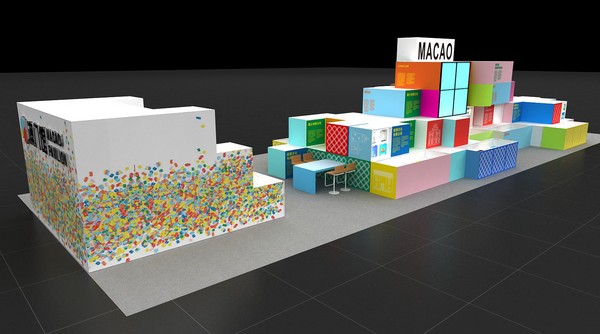
Aiming at strengthening exchange and cooperation between Macao and Beijing, the Cultural Affairs Bureau (IC) is organizing the participation of Macao's cultural and creative entities in the 8th China Beijing International Cultural & Creative Industry Expo 2013 (ICCIE). To be held from November 7 to 10 at the China International Exhibition Center. The "Macao Pavilion" will be set up at the ICCIE for onsite showcase of the city's creative panorama and sales of creative products. With the theme of "culture and technology joint development", ICCIE 2013 aims to bring together high-end technology and products of cultural and creative contents from home and abroad, through exhibitions, displays, performances, creative events, business presentations and transactions, forums and summits. Its objective is to build a significant platform for industries on information exchange, commodity transaction and project cooperation. The ultimate goal is to provide cultural and creative products a wider field for the commercial, industrial and international expansion, thereby turning ICCIE into a global cultural and creative hub blending creativity, technology and culture. The "Macao Pavilion", with an area of 243 square meters, will be set in the Cultural and Creative Industries Exhibition Area. The theme and design concept will pursue the "Macao Pavilion" presented at the China International Cultural Industries Fair, held in Shenzhen in May 2013, in an attempt to introduce Macao's World Heritage to Beijing audiences, while showcasing its cultural and creative thematic products. The 5-metre-high pavilion draws on 3D geometrics, bright colors, as well as Macao World Heritage and cultural and creative elements to highlight the SAR as a vibrant, culturally diverse city. Besides presenting the history and features of Macao World Heritage sites, it also promotes local creative brands and products, fostering the development of cultural and creative industries by introducing them to a world audience, pushing them to go global. Macao exhibitors at ICCIE 2013 include: Art House, the Creative Industries Promotion Association of St. Lazarus Church District, Lines Lab, Macau Creations, Macao Daily News, Macao Heritage Ambassadors Association, MOD Design Store , Ribs Clothing Limited, San Seng Fung, and Soda Panda Product Design.
…
Monetary and Financial Statistics – September 2013
According to statistics released today by the Monetary Authority of Macao, broad money supply continued to grow in September. As total deposits increased at a faster pace than total loans, the overall loan-to-deposit ratio of the banking sector dropped from a month earlier.
Money supply
Currency in circulation grew 0.9% whereas demand deposits dropped 2.7%. M1 thus decreased 2.2% from one month earlier. Concurrently, quasi-monetary liabilities increased 2.3%. The sum of these two items, i.e. M2, grew 1.7% to MOP426.6 billion. On an annual basis, M1 and M2 rose 33.7% and 22.5% respectively. The share of Pataca (MOP) in M2 stood at 24.3%, down at the same pace of 0.3 percentage points from a month and a year earlier. The share of Hong Kong Dollar (HKD) in M2 was 53.4%, up 0.5 percentage points month-to-month but down 2.7 percentage points year-on-year.
Deposits
Resident deposits grew 1.8% from the preceding month to MOP417.9 billion. Of which, MOP deposits, HKD deposits and other foreign currency deposits increased at respective rates of 0.4%, 2.7% and 0.9%. Non-resident deposits rose 8.2% to MOP174.1 billion. Public sector deposits with the banking sector also increased 3.3% to MOP63.9 billion. As a result, total deposits with the banking sector grew 3.5% from a month earlier to MOP656.0 billion. The shares of MOP and HKD in total deposits were 19.5% and 44.7% respectively.
Loans
Domestic loans to the private sector increased 1.0% from a month ago to MOP243.3 billion. Among which, MOP77.9 billion was MOP-denominated and MOP142.1 billion was denominated in HKD, representing 32.0% and 58.4% of the total respectively. Analysed by economic sector, loans to "wholesale and retail trade", "construction and public works" and "exhibition and conference" increased at respective rates of 12.9%, 8.7% and 7.8% compared with a quarter ago, whereas loans to "electricity, gas and water" and "agriculture and fisheries" dropped 6.2% and 2.0% respectively. External loans increased 0.7% to MOP268.9 billion; of which, loans denominated in MOP and HKD accounted for 1.3% (MOP3.6 billion) and 22.6% (MOP60.9 billion) respectively.
Loan-to-deposit ratios
The loan-to-deposit ratio for the resident sector at end-September dropped 0.5 percentage points from the previous month to 50.5%. The ratio for both the resident and non-resident sectors also decreased 2.1 percentage points to 78.1%.
…
Vice Premier in Macao for opening of 4th Forum
The Vice Premier, Mr Wang Yang, arrived in Macao at 12:30 today and was met at the airport by the Chief Executive, Mr Chui Sai On. Mr Wang will deliver a keynote speech at tomorrow's opening ceremony of the 4th Ministerial Conference of the Forum for Economic and Trade Cooperation between China and Portuguese-speaking Countries, which also celebrates the 10th Anniversary of the Establishment of the Forum. In the afternoon, the Vice Premier received Mr Chui at the Xin Zhu Yuan (New Bamboo Court), a venue where state leaders receive important guests when the leaders visit Macao. Afterwards, Mr Wang held several bilateral meetings with official representatives from Guinea-Bissau, Portugal, Timor-leste and Brazil in succession at the Macao Dome, where the opening ceremony is to be held. Mr Chui was also present at the meetings. Mr Wang received the Vice-Chairman of the National Committee of CPPCC, Mr Edmund Ho at the Dome in the evening before the welcome banquet. The Ministry of Commerce and the Macao Government hosted the welcome banquet for the guests and Mr Wang Yang, Mr Edmund Ho, Mr Chui, the Minister of Commerce of the People's Republic of China, Mr Gao Hucheng, the Director of the Liaison Office of the Central People's Government in the Macao Special Administrative Region, Mr. Bai Zhijian, and leaders of the Portuguese-speaking countries. Minister of Commerce, Mr Gao, who spoke at the banquet, said the Macao Forum has gone through an extraordinary decade since its inception in 2003. Over this time, China and the Portuguese-speaking countries have been firmly committed to the path of tackling difficulties through concerted efforts, and holding up the principles of mutual benefit, win-win co-operation and drawing on each other's advantages. He said that by standing at the new historical starting point, China and the Portuguese-speaking countries will continue to take full advantage of the Macao Forum as platform for co-operation, given full play to the strengths of each party, step up the practical co-operation on a larger scale and in broader areas. The Chief Executive said in his speech that with the massive support of the Central Government as well as the concerted efforts and contribution of the various Portuguese-speaking countries, the Ministerial Conference has achieved encouraging progress in trade and economic collaboration between China and the Portuguese-speaking countries in the decade since the inception of the 1st Ministerial Conference in 2003, resulting in the successive advancement and strengthening of co-operation in various areas. He said the Forum has become an effective reciprocation mechanism and an efficient service platform which continues to play an essential role in sustaining trade and economic co-operation between China and Portuguese-speaking countries. Mr Chui said the Macao Government is deeply honoured to be the co-organiser of the event, which is an illustration of the Central Government's support and trust in the Macao SAR, and also recognition of Macao's status as a trade and economic co-operation service platform between China and the Portuguese-speaking countries. Mr Chui also expressed his sincere gratitude to the Ministry of Commerce for the tremendous support over last ten years.
…
Macau and East Timor sign Memorandum of Understanding for cooperation in tourism to strengthen collaborative relation for mutual benefit
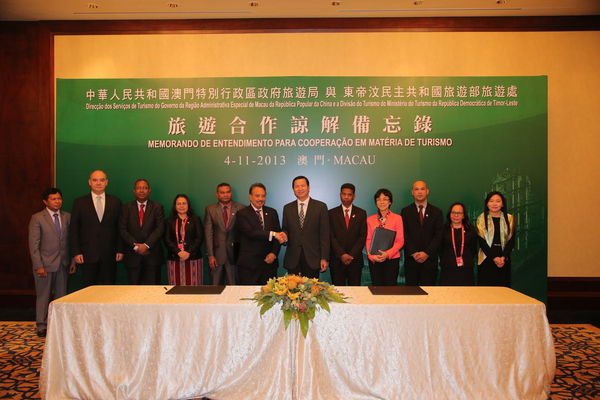
Macau Government Tourist Office (MGTO) signed a memorandum of understanding (MOU) for cooperation in tourism with the Division of Tourism, Ministry of Tourism of the Democratic Republic of Timor-Leste ("East Timor") today (4 November) to strengthen their collaborative relation for mutual benefit. The officials who attended and witnessed the signing ceremony are as follow: Secretary for Social Affairs and Culture of the Macau Special Administrative Region Government, Cheong U; Minister of Tourism of East Timor, Francisco Kobualdi Lay; Minister of Trade, Industry and Environment of East Timor, António da Conceição; Secretary of State for Support and Promotion of the Private Sector of East Timor, Veneranda Lemos Martins; Secretary of State for Social Communication of East Timor, Nélio Issac Sarmento; Deputy Secretary-General of the Secretariat of China and Portuguese-Speaking Countries Economic Cooperation Forum, Marcelo D'Almeida; East-Timor Ambassador to China, Vicky Tchong; MGTO Deputy Director, Manuel Pires; MGTO Deputy Director, Cecilia Tse; and the Representative of East Timor, the Secretariat of China and Portuguese-Speaking Countries Economic Cooperation Forum, Cornélio Ferreira. Director of MGTO, Maria Helena de Senna Fernandes and Director-General of the Division of Tourism, Ministry of Tourism of the Democratic Republic of East Timor, Silvino Sampaio Gonçalves signed the MOU for cooperation in tourism. Considering the friendly and collaborative relation between Macau and East Timor, both parties agreed to sign the MOU in order to begin and promote their multifaceted cooperation in tourism. For the main purpose of training talents in the tourism industry while considering its significance to the economy of Macau and East Timor, the memorandum aims at eight objectives as follow: exchange information on formulation, definition and implementation of policies in the tourism sector; share experience regarding planning, management and certification system of tourism activities; develop collaborative relations and partnership between small and medium-sized tourism enterprises of Macau and East Timor; assist the tourism sector, travel agencies and hotels in organizing promotional activities; exchange information on tourism market trends as well as other technical and statistical data; assist in establishing an incentive system for promotion of the tourism industry; tourism promotion primarily through studies on the tourism image of both destinations, promotional activities, participation in travel fairs and business forums as well as other related activities; training and skill development of technical talents in the above fields. Macau and East Timor collaborate with each other through a variety of ways including familiarization visits, information and document exchange, technical assistance, offering suggestions and training. The 4th Ministerial Conference of China and Portuguese-Speaking Countries Economic Cooperation Forum (Macau) will soon be opened in Macau. The signing of MOU for cooperation in tourism between Macau and East Timor is listed as part of the program in this year's forum.
…
Conference on “European Environmental Standards and Policies”
The conference on "European Environmental Standards and Policies", being part of the 2nd EU-Macao Co-operation Programme in the Legal Field, will take place on November 5th from 9:15 a.m. to 6:00 p.m. and on November 6th from 9:30 a.m. to 12:00 p.m., in the Lotus Room of the Hotel Grand Lapa, located at Avenida de Amizade n.° 956-1110. This event is jointly organized by the Institute of European Studies of Macau and by the Law Reform and International Law Bureau. This activity will feature as its guest speakers Dr. Ramos Preto, Deputy in the XII Legislature at the Assembly of the Republic of Portugal, Chairman of the Parliamentary Committee on the Environment, Planning and Local Government; and Mr. José Eduardo Martins, Former Secretary of State for the Environment, Heads of the Environmental and Public Law Department, and Partner with Abreu Advogados. The conference will be conducted in English with simultaneous translation into Mandarin and this training initiative is set out into five modules: 1. Law of the air and atmosphere;
2. The waste management policy in the EU;
3. Tackling climate change;
4. Environmental liability – preventing and remedying environmental damage;
5. European Environmental Law – Overview of the last three decades. The 2nd EU-Macao Co-operation Programme in the Legal Field, which incorporates this conference, has as its main objective the "Consolidation of the Macao Legal System" and will take place until December 2013. The execution of this Programme is coordinated by the Law Reform and International Law Bureau, with the participation of several other MSAR's entities and public departments, namely the Legal and Judicial Training Centre, the Legal Affairs Bureau, the Economic Services, the Financial Services Bureau and the Institute of European Studies of Macao.
…
Fourth Ministerial Conference of the Forum for Economic and Trade Cooperation between China and Portuguese-speaking Countries opens in Macao next week
Vice Minister Mr Wang Yang is scheduled to come to Macao for the opening of the Fourth Ministerial Conference of the Forum for Economic and Trade Cooperation between China and the Portuguese-speaking Countries, which takes place here on 4 to 6 November. The event will be highlighted by the presence of Mr Wang and high ranking officials from some Portuguese-speaking countries, including the Prime Minister of Guinea-Bissau, Mr Rui Duarte Barros; the Vice President of Brazil, Mr Michel Temer; Deputy Prime Minister of Portugal, Mr Paulo Portas; Deputy Prime Minister of East Timor, Fernando de Araújo; the Minister of Tourism, Industry and Energy of Cape Verde, Mr Humberto Santos de Brito; the Minister of Foreign Affairs of Mozambique, Mr Oldemiro Balói, and the Minister of Justice and Human Rights Mr Rui Mangueira. A celebratory conference for the 10th anniversary of the Forum for Economic and Trade Cooperation between China and Portuguese-speaking Countries on the morning of 5 November. The Vice Minister will make a keynote speech at the conference, and heads of delegations from Guinea-Bissau, Brazil, Portugal, East Timor, Cape Verde, Mozambique and Angola will also be speaking. The conference will be hosted by the Minister of Commerce, Mr Gao Hucheng. The Fourth Ministerial Conference of the Forum for Economic and Trade Cooperation between China and Portuguese-speaking countries will take place on the afternoon of 5 Novermber. During the conference, representatives from China and the Portuguese-speaking Countries will discuss directions and ways to boost trade and economic co-operation, and will sign related documents. On the morning of 6 November, a conference for industry representatives and a matching seminar for the development foundation between China and the Portuguese-speaking countries will be launched, at Venetian Macau. The Vice Minister of Commerce, Ms Gao Yan, the Secretary for Economy and Finance, Mr Tam Pak Yuen, ministers from the Portuguese-speaking countries, the management from China Development Bank and China Council for the Promotion of International Trade (CCPIT) will deliver speeches at the event. The conference will be hosted by the President of Macao Trade and Investment Promotion Institute, Mr Cheong Chou Weng. Since its inauguration in 2003, the Forum for Economic and Trade Cooperation between China and Portuguese-speaking Countries has increasingly become an important platform for co-operation and development between China and Portuguese-speaking countries. The Fourth edition of the event will captitalise on Macao's role as an economic and trading platform and boost economic co-operation for the participants.
…