

Macao SAR Government Portal
News
Results of the Survey on Manpower Needs and Wages for the 1st Quarter 2012
The Statistics and Census Service (DSEC) released results of the Survey on Manpower Needs and Wages for the first quarter of 2012. Survey coverage comprised the Manufacturing sector; Hotels & Restaurants; the Insurance sector; Financial Intermediation Activities and the Electricity, Gas & Water Supply sector, excluding own-account workers, as well as insurance agents and brokers not directly employed by insurance companies. At the end of the first quarter of 2012, the Manufacturing sector had 11,160 paid employees, down by 10.4% year-on-year, with those working in Manufacture of Wearing Apparel (3,897) and Manufacture of Textiles (608) decreasing significantly by 26.1% and 27.9% respectively. In addition, there were 3,180 paid employees in Manufacturing of Food Products, up by 10.8% year-on-year. In March 2012, average earnings (excluding bonuses and allowances) of full-time employees rose by 13.6% year-on-year to MOP7,340, with Sewing machine operators earning MOP3,610 in average. Hotels & Restaurants took on 63,204 paid employees, up by 17.2% year-on-year. With new hotels coming into operation, number of paid employees in hotels surged significantly by 18.7% year-on-year to 41,722. In March, average earnings of full-time employees rose by 4.4% year-on-year to MOP11,170. Waiters/waitresses of hotels earned an average of MOP7,790, while those of restaurants earned MOP6,480. Housekeeping staff earned MOP7,210. The Electricity, Gas & Water Supply sector had 1,062 paid employees, unchanged year-on-year. Average earnings of full-time employees increased by 2.8% over March 2011 to MOP22,860. The Insurance sector took on 458 paid employees, up by 1.3% year-on-year. Average earnings of full-time employees in March rose by 9.1% year-on-year to MOP20,450. Financial Intermediation Activities had 445 paid employees, up by 5.0% year-on-year. In March, average earnings of full-time employees increased by 8.7% year-on-year to MOP12,750. At the end of the first quarter of 2012, the Hotel sector reported 2,457 vacancies, down significantly by 53.2% from the third quarter of 2011; restaurants had 3,362 vacancies; meanwhile, Manufacturing offered 1,449 vacancies of which 588 were in Manufacture of Food Products and 480 in Manufacture of Wearing Apparels. In terms of recruitment prerequisites, 65.0% of the vacant posts in Insurance sector and 59.8% of those in Hotels & Restaurants required work experience. As regards educational attainment, 76.3% of the vacancies in the Manufacturing sector and 68.9% in the Hotels & Restaurants required junior secondary education or lower; meanwhile, all of those in the Insurance sector and 80.0% of the vacancies in Financial Intermediation Activities required senior secondary education or higher. Besides Cantonese, knowledge of Mandarin and English were respectively required in 85.0% and 95.0% of the vacancies in the Insurance sector; meanwhile, the respective percentages for those in Hotels & Restaurants were 58.7% and 41.9%. With respect to the indicators that measure inflow and outflow of human resources, as well as staffing needs, Hotels & Restaurants had the highest employee recruitment rate (11.2%) and employee turnover rate (7.5%), indicating rapid turnover of employees in this sector. The Manufacturing sector had the highest job vacancy rate of 12.4%, which was followed by the Hotels & Restaurants, at 9.0%.
…
International Banking Statistics, March 2012
According to the statistics released today by the Monetary Authority of Macao, the proportion of international business in the local banking sector remained high in the first quarter of 2012. At end-March 2012, the share of international assets in total banking assets remained virtually unchanged from end-2011 at 84.7%, while the share of international liabilities in total banking liabilities advanced to 81.3% from 79.7%. Foreign currencies were the dominant denomination in international banking transactions. At end-March 2012, the shares of Pataca (MOP) in total international assets and total international liabilities were 0.4% and 1.6% respectively. Hong Kong Dollar (HKD) and Other Foreign Currencies (OFCs) accounted for 39.9% and 59.7% of total international assets as well as 44.6% and 53.9% of total international liabilities respectively. International Banking Assets
At end-March 2012, total international assets grew by 7.3% from a quarter ago or 18.3% from a year earlier to MOP598.1 billion (USD74.8 billion). Within this total, external assets and local assets in foreign currencies expanded year-on-year by 17.4% to MOP460.3 billion and 21.5% to MOP137.8 billion respectively. As a major component of international assets, external loans & deposits increased by 17.5% to MOP431.2 billion. In particular, cross-border non-bank loans expanded by 23.1%. International Banking Liabilities
Total international liabilities went up by 9.6% from three months ago or 23.8% year-on-year to MOP574.3 billion (USD71.8 billion). Of this total, external liabilities and local liabilities in foreign currencies grew year-on-year by 24.0% to MOP312.9 billion and 23.6% to MOP261.4 billion respectively. Foreign currency deposits held by residents continued to form a major component of international liabilities. This type of deposits grew by 24.4% to MOP242.5 billion at end-March 2012 from MOP194.9 billion at end-March 2011. Concurrently, overseas non-bank deposits increased by 44.3%. Breakdown of External Banking Assets and Liabilities by Region
The majority of external assets and liabilities were related to the regions of Asia and Europe. At end-March 2012, claims on Hong Kong and Mainland China occupied 35.5% and 23.4% of total external assets respectively, while claims on Portugal and Luxembourg took up 10.6% and 2.7% correspondingly. On external liabilities, Hong Kong and Mainland China accounted for 46.3% and 9.7% of the total respectively while France and Portugal took up respective shares of 5.4% and 2.6%. The compilation of International Banking Statistics follows the methodology advocated by the Bank for International Settlements in order to facilitate Macao SAR's participation in the "Locational International Banking Statistics" project of the international organisation. For enquiry, please contact:
Research and Statistics Department, Monetary Authority of Macao
(Tel:83952532; Fax:28353042)
…
Environmental Statistics 2011
According to the Environmental Statistics 2011 released by the Statistics and Census Service (DSEC), total land area of Macao measured 29.9 km2 at the end of 2011, up by 0.7% year-on-year; the population density rose by 1.7% to 18,400 people per km2. Total lane length of public roads was 416.0 km, and the motor vehicle density was 496 vehicles per km, up by 0.6% and 4.2% respectively year-on-year. In 2011, total rainfall decreased significantly by 37.2% year-on-year to 1,363.6 mm; the lowest pH value of rainwater was 3.5 (precipitation with pH value lower than 5.6 is classified as acid rain). Number of days with a Low to Moderate ultraviolet index level increased by 5.3% year-on-year to 337. As regards air quality level, the Northern District monitoring station recorded 294 days of good air quality in 2011, up by 20 days year-on-year, representing five consecutive years of increase; the Rua do Campo monitoring station registered 270 days, down by 19 days year-on-year. The quality of potable water from the distribution network and Water Treatment Plants of Macao conformed to the standard according to the results of the analysis carried out by the Laboratory of the Civic and Municipal Affairs Bureau. The salinity level of potable water was classified as Low in 2011. Volume of domestic garbage collected by the Macau Waste Systems Company Limited rose slightly by 0.5% year-on-year to 166,000 tonnes, while that from the business sector increased by 9.3% to 98,000 tonnes. A total of 329,000 tonnes of garbage were processed in the Incineration Plant, up by 2.4% year-on-year. Volume of waste transported to landfill site for construction materials decreased substantially by 17.2% to 1,618,000 m3. In 2011, the average volume of waste water treated by the 4 Waste Water Treatments Plants in Macau was 186,000 m3 per day, down by 1.2% over 2010. With respect to environmental activities, the Civic and Municipal Affairs Bureau and the Environmental Protection Bureau together collected 447 tonnes of paper, 63 tonnes of plastic materials and 25 tonnes of metallic materials for recycling in 2011; moreover, a total of 1,290 promotional activities were organized, with approximately 538,000 participants.
…
Visitor Arrivals for April 2012
Information from the Statistics and Census Service (DSEC) indicated that visitor arrivals increased by 1.9% year-on-year to 2,382,156 in April 2012; same-day visitors (1,257,210) accounted for 52.8% of the total. The average length of stay of visitors increased by 0.1 day year-on-year to 1.1 days, with that of overnight visitors and same-day visitors being 2.1 days and 0.2 day respectively. Analyzed by place of residence, visitors from Mainland China increased by 9.5% year-on-year to 1,391,119 (58.4% of total), mostly from Guangdong Province (641,433), Fujian Province (72,755), Zhejiang Province (50,776) and Hunan Province (49,920). Mainland visitors travelling to Macao under the Individual Visit Scheme (IVS) totalled 541,551, up by 9.3% year-on-year. The average length of stay of Mainland visitors was 1.1 days, with that of overnight visitors at 2.2 days. Visitors from Hong Kong (654,803); and Taiwan, China (85,718) decreased by 7.7% and 22.4% respectively year-on-year; however, those from the Philippines (28,972), the Republic of Korea (28,119) and Japan (26,591) increased by 20.0%, 8.7% and 24.0%. Besides, long-haul visitors from the Americas (29,460) and Europe (24,786) also recorded year-on-year increase of 5.7% and 3.1% respectively, while those from Oceania (12,173) decreased by 2.9%. In the first four months of 2012, visitor arrivals increased by 6.3% year-on-year to 9,324,476. Visitors from Mainland China (5,618,826), the Republic of Korea (153,701) and Japan (137,864) increased by 13.5%, 16.2% and 11.3% respectively; long-haul visitors also registered year-on-year increase. Visitors from Hong Kong (2,375,016) and Taiwan, China (335,532) decreased by 4.5% and 13.1% respectively. Same-day visitors accounted for 54.0% of the total at 5,038,499.
…
Results of Visitor Expenditure Survey for the 1st Quarter 2012
In view of providing more information on inbound visitor expenditure from different places, the Statistics and Census Service releases data on visitors' spending of six additional countries, namely Malaysia; Singapore; Thailand; the United States; the United Kingdom; and Australia, starting from the first quarter of 2012. Total spending (excluding gaming expenses) of visitors, which was extrapolated from about 43,000 effective samples, reached MOP 13.1 billion in the first quarter of 2012, up notably by 35% year-on-year. Total spending of overnight visitors surged by 39% year-on-year to MOP 10.6 billion, and that of same-day visitors increased by 19% to MOP 2.5 billion. Moreover, total non-shopping spending and shopping spending of visitors amounted to MOP 6.4 billion and MOP 6.7 billion, up by 28% and 42% respectively year-on-year. In the first quarter of 2012, per-capita spending of visitors was MOP 1,891, an increase of 25% from a year earlier. Analyzed by place of residence, per-capita spending of those from Mainland China stood at MOP 2,435; Singapore at MOP 1,448; and Malaysia at MOP 1,375. Meanwhile, per-capita spending of long-haul visitors from Australia, the United States of America and the United Kingdom was MOP 1,316, MOP 1,186 and MOP 1,018 respectively. Moreover, per-capita spending of overnight visitors increased by 28% year-on-year to MOP 3,358 and that of same-day visitors rose by 11% to MOP 665. Per-capita spending of overnight and same-day visitors from Mainland China topped at MOP 4,391 and MOP 842. Per-capita non-shopping spending of visitors rose by 18% year-on-year to MOP 921, of which expenses on Accommodation and Food & Beverage accounted for 48% and 36% respectively. Per-capita non-shopping spending of Japanese visitors took the lead at MOP 1,192; for long-haul visitors, those from Australia had the highest per-capita non-shopping spending of MOP 1,092. Per-capita shopping spending of visitors was MOP 971, up by 31% over the same quarter of 2011, with Local Food Products (22%), Jewellery & Watches (19%) and Clothing (17%) being the more popular shopping items. However, per-capita shopping spending of Mainland visitors reached MOP 1,464.
…
Results of Retail Sales Survey for the 1st Quarter 2012
Information from the Statistics and Census Service indicated that value of retail sales for the first quarter of 2012 reached MOP 12.88 billion, up by 28% year-on-year. Retail sales of Watches, Clocks and Jewellery Goods amounted to MOP 4.03 billion (31% of total), which was followed by retail sales of Goods in Department Stores (15%), Adults' Clothing (11%), Leather Goods (10%), Goods in Supermarkets (6%) and Motor Vehicles (6%). Value of retail sales for the first quarter of 2012 increased by 4% compared with the revised figure (MOP 12.43 billion) of the fourth quarter of 2011, with marked increase being observed in sales of Adults' Clothing (+19%), Communication Equipment (+13%) and Watches, Clocks and Jewellery Goods (+8%); however, retail sales of Motor Vehicles decreased by 17%. Value of retail sales for the first quarter of 2012 surged 28% year-on-year, with notable increase being observed in sales of Adults' Clothing (+43%), Watches, Clocks and Jewellery Goods (+43%) and Communication Equipment (+41%). After removing the effect of price changes, volume of retail sales for the first quarter of 2012 increased by 18% year-on-year, of which sales of Communication Equipment soared by 50%, Adults' Clothing by 40% and Goods in Department Stores by 30%. Volume of retail sales increased by 3% quarter-to-quarter, with significant increase in sales of Adults' Clothing (+23%) and Communication Equipment (+10%); on the contrary, sales volume of Motor Vehicles registered a decrease of 18%. In respect of the comments of the retailers, about 54% stated that sales volume in the first quarter of 2012 held stable or increased over the previous quarter, down by 26 percentage points compared with those holding the same sentiment in the fourth quarter of 2011; while 46% reported a decrease in sales volume. In terms of the retail prices, about 53% reported stable prices, 38% stated an increase and 9% reported a decrease. In comparison with the same quarter of 2011, about 70% expressed that the stock level was normal in the first quarter of 2012, while 15% indicated that the stock level was low. As regards the business outlook for the second quarter of 2012, about 79% anticipate that sales volume will increase or remain stable from the first quarter of 2012, while 21% expect a decrease. Concurrently, about 19% predict an increase in retail prices, 75% expect stable prices and 6% expect a decrease.
…
Consumer Council released May’s ‘Supermarket Price Survey’
Consumer Council released its latest 'Supermarket Price Survey' dated 17th May. This month's survey revealed stability in prices of most products, including prices of most of the cooking oil products surveyed; prices of one cooking oil brand had decreased by 7%. The 'Supermarket Price Survey' of May revealed stability in prices of most categories of products. In comparison with last month's data, prices of 108 out of over 300 items surveyed had dropped while those of 92 items remained stable, which amounted to about 60 percent of the total number of items surveyed. Average prices of 113 items, mainly canned foods, shampoos and household cleansing product, had been raised since last survey. The Council added that both price increases and decreases recorded were both minimal, ranging from less than 1 percent to 5 percent. Obvious price increases were shown in cooking oil items in previous surveys, however, among the 25 cooking oil brands surveyed this time, prices of 17 items recorded price drops; 'Mazola Canola Oil (3.5L)' recorded the biggest drop of 7.5 percent. Prices of rice also remained stable, most of the items surveyed recorded no change in price, 'Wing On Thai White Fragrant Rice (5kg)' recorded a price drop of almost 8.5 percent. The current survey also showed that two branches of San Miu Supermarket, located at Rua dos Mercadores and La Baie Du Noble, were found to have different selling prices for over 100 items and those prices varied for up to 20%. Similar cases were observed in branches of Royal Supermarket and PARKnSHOP but the price differences were comparatively small. Consumers are advised to check with the data provided by the Council on its website and its 'Supermarket price platform' iPhone and Android app for easy reference. The latest 'Supermarket Price Survey' is now available on the Council's website (www.consumer.gov.mo) and the 'Supermarket Price Information Platform' iPhone and Android app. The survey is also available free of charge at the offices of Consumer Council, IACM's Iao Hon and S. Domingos Markets, bookstores and libraries. Consumers may also access the resources through WAP channels on their mobile phones. For inquiries, please call 8988 9315.
…
Mortgage Loans Statistics, 1st Quarter 2012
According to statistics released today by the Monetary Authority of Macao, new approvals of residential mortgage loans (RMLs) rose whereas commercial real estate loans (CRELs) dropped in the first quarter of 2012. With regard to outstanding balance, RMLs rose while CRELs witnessed decrease. New Lending Approved For the first quarter of 2012, new RMLs approved by Macao banks rose 22.0% quarter-to-quarter to MOP5.7 billion; of which, 93.9% was extended to residents. In terms of approved value, new RMLs to residents grew 26.0% whereas those to non-residents dropped 17.9%. When compared with the same period of 2011, new approvals of RMLs dropped by 33.2%. New RMLs collateralised by uncompleted units (i.e. equitable mortgage) dropped 4.8% quarter-to-quarter to MOP118 million; of which 77.1% was extended to residents. The equitable mortgage to residents dropped 26.6%. When compared with the same period of 2011, equitable mortgage contracted by 92.4%. After registering decrease in the previous quarter, new CRELs approved further declined by 45.8% quarter-to-quarter to MOP5.7 billion; of which, 75.6% was granted to residents. In terms of approved value, new CRELs to residents contracted 56.2% whereas those to non-residents rose 103.8%. On an annual basis, new approvals of CRELs dropped 8.6%. Outstanding Balances As at end-March 2012, the outstanding value of RMLs reached MOP77.9 billion, an increase of 2.2% from three months earlier or 19.4% from a year ago. The resident component made up 92.3% of the total. Outstanding RMLs to residents grew by 2.7% when compared with three months earlier while those to non-residents dropped 3.3%. Concurrently, the outstanding value of CRELs dropped 2.6% from end-December 2011 but rose 20.2% from end-March 2011 to MOP61.1 billion. Residents accounted for 90.6% of the loans. Compared with three months earlier, outstanding CRELs to residents dropped 3.0% whereas those to non-residents rose 1.9%. Delinquency Ratios At the end of March 2012, the delinquency ratio for RMLs stood at 0.08%, down 0.01 percentage point from three months earlier and a year ago. The ratio for CRELs went down 0.01 percentage point from end-December 2011 or 0.32 percentage points from end-March 2011, to 0.09%. For enquiry, please contact:
Research and Statistics Department Monetary Authority of Macao
(Tel:83952532; Fax:28353042)
…
CE to visit Beijing and Sichuan
The Chief Executive, Mr Chui Sai On, is scheduled to visit Beijing for the first China Beijing International Fair for Trade in Services (CIFTIS), which opens on 28 May.
Mr Chui is to meet with the Mayor of Beijing, Mr Guo Jinlong, and attend the opening ceremony of the fair.
From there he is to proceed to Sichuan to attend the celebration of the completion of a stadium sponsored by the Macao Government.
Accompanied by the Secretary for Economy and Finance, Mr Tam Pak Yuen, Mr Chui will leave for Beijing on 26 May. CIFTIS, approved by the State Council, the Ministry of Commerce of the People's Republic of China and the People's Government of Beijing Municipality, will be jointly hosted as an annual event thereafter. The fair is defined as a national-level, internationalized and comprehensive fair for trade in services which is currently the only comprehensive trading platform in the world with a coverage of 12 fields of trade in services as defined by the WTO, i.e. the business services, communication services, construction and related engineering services, distribution services, education services, environmental services, financial services, health and social services, tourism and travel related services, recreational culture and sports services, transportation services and other services. .
Mr Chui and his official delegation will go on to Sichuan on the afternoon of 28 May where they will attend the festivities to celebrate the completion of the multi-functional stadium sponsored by the Macao Government. The stadium, with a total construction area of 25, 500 square metres, is one of the key restoration projects following the tragic earthquakes which hit Wenchuan on 12 May 2008.
Members of the official delegations would include the Chief-of-Cabinet of the Office of the Chief Executive, Mr Tam Chon Weng, the Secretary-General of the Executive Council, Ms O Lam, the Director of Government Information Bureau, Mr Chan Chi Ping. Mr Chui will return Macao on 30 May. In his absence, the Secretary for Administration and Justice, Ms Florinda Chan, will be the acting Chief Executive.
…
Learning with Social Care IFT Students Organised Fundraising Activity for ORBIS
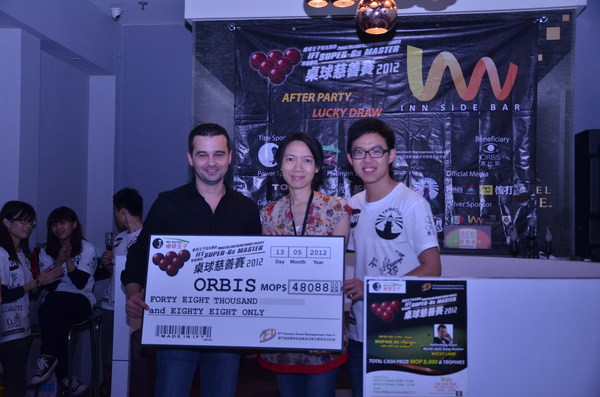
Tourism Event Management Year 4 students of Institute for Tourism Studies (IFT) hosted a successful fundraising event. "PRINCE BILLIARD SALOON PROUDLY PRESENTS: IFT SUPER-6s MASTER" was held successfully on 12 and 13 May in Prince Billiard Saloon. There were 33 teams, players included former Macao Team members and local undergraduates. The Vice President of IFT, Ms. Florence Ian, Director of Development of ORBIS, Ms. Vivian Lo and representatives from sponsors officiated the opening ceremony. The organising team aims this tournament to promote billiard to the public and at the same time to support charity institutions in Macao. This is also a great opportunity for students to put the theories they learnt in class into practice. Profit generated, MOP55,000, including the cash prizes (MOP7,000) donated from the champion and the first runner up, was donated to ORBIS, an international non-profit making charity organisation for restoring sight and eliminating avoidable blindness long-term worldwide project. Rocky Lane, the world record holder of jump shooting from New Zealand was invited to perform during the event. Rocky is the fastest player of jump shooting and potting 15 pool balls from the table, in 14.16 seconds, still unbeaten. The after party was held in the evening on 13 May in Inn Side Bar with wine tasting sponsored by Tosti. The party included the award and cheque presentation ceremony, followed with lucky draw sponsored by IGT.
…