

Macao SAR Government Portal
News
22nd Macao Arts Festival Tickets on Sale from Sunday 27th March
Organized by the Cultural Affairs Bureau, the 22nd Macao Arts Festival (MAF), to be held from 29th April to the 28th May, features a total of 29 distinguished performances of different cultural and artistic genres from 9 different countries and regions. This year the MAF has chosen “Enjoy Life through Arts”. Tickets for all performances will be on sale from this coming Sunday (March 27th at 10am) at all Kong Seng Ticketing outlets, whereas telephone and online bookings will be available from 1pm on the same day. The organiser will distribute queuing tickets at Kong Seng ticketing outlets at 9am on 27th March. This year's MAF boasts a wide variety of performances. Admission tickets to popular performances will surely be the most sought after by the public. To best secure residents' equal opportunity to cultural and artistic performances, on the first day of ticket sales, ticket sales for the Cantonese opera performance De Ling and Empress Dowager Ci Xi and for the children's performance Ti-tó-tis – Music and Dance for Babies are limited to a maximum of 4 tickets per performance per person. Likewise, on the first day of sale Ticket sales for all other performances are limited to a maximum of 10 tickets per performance per person. The performance Ti-tó-tis – Music and Dance for Babies is aimed for children under the age of 3. Each ticket provides free admission for two extra persons (maximum) aged 4 or above. Due to the special layout of the venue, only one person is allowed to accompany the child to the stage area. Consistently aiming at drawing Macao residents closer to the arts, the MAF offers discounted ticket sales, as usual, including 40% off for purchase of tickets for at least 4 different performances, for purchase of 10 or more tickets for the same performance, holders of Student Cards (full-time students only) and holders of Macao Senior Citizen Cards. In addition, a 20% discount is available for holders of MET (Macao Entertainment and Tourism) cards, teacher cards, youth cards, credit cardholders of Bank of China Macau Branch, Banco Weng Hang S.A., ICBC Macau, Luso International Banking Ltd., BCM Bank and BNU, and holders of Bank of China Tri-Currency Debit Card. Furthermore, to support local artists, 40% discount upon simultaneous purchase of 2 tickets for any 2 local performances (marked “ ”)(only available for performances at the Macao Cultural Centre, Dom Pedro V Theatre and the Macao Tower Auditorium) Detailed information about the MAF is available in the MAF booklet, which can be obtained at the Cultural Affairs Bureau, Tap Seac Gallery, Kong Seng Ticketing, Macao Conservatory, Macao Central Library, CTM (Rua Pedro Coutinho Branch and Taipa Branch), Macau Cultural Centre, Public Information Centre, various bookstores and music companies, Café Ou Mun, Clube Militar de Macau, Litoral Restaurant and Akasaka Café, etc. To support a green environment, you may also download the electronic booklet from www.icm.gov.mo/fam. For enquiries, please call 8399 6699. For telephone bookings, please call the MAF 24-hour hotline 2855 5555 (Macao), 2380 5083 (Hong Kong) and 139 2691 1111 (Mainland China). Online booking is available at www.macauticket.com.
…
Latest Monitoring of the Ambient Gamma Radiation in Macao
According to the monitoring data of Gamma Radiation recorded for the past 24 hours (24th March 16:01 till 25th March 16:00) by the Taipa Grande Station of the Macao Meteorological Bureau, the Gamma-ray absorbed dose rate per minute ranges between 0.1187 and 0.1318μGy/h (micro Gray / hour) which is far more below the warning level of 0.35μGy/h. The Macao Meteorological Bureau will continue to pay close attention to this nuclear incident in Japan and monitor for any possible impact on Macao. If any abnormalities being discovered, we will release related message to the public immediately and inform relevant government departments to adopt relative contingency measures.
…
Latest Monitoring of the Ambient Gamma Radiation in Macao
According to the monitoring data of Gamma Radiation recorded for the past 24 hours (24th March 10:01 till 25th March 10:00) by the Taipa Grande Station of the Macao Meteorological Bureau, the Gamma-ray absorbed dose rate per minute ranges between 0.1187 and 0.1318μGy/h (micro Gray / hour) which is far more below the warning level of 0.35μGy/h. The Macao Meteorological Bureau will continue to pay close attention to this nuclear incident in Japan and monitor for any possible impact on Macao. If any abnormalities being discovered, we will release related message to the public immediately and inform relevant government departments to adopt relative contingency measures.
…
Latest Monitoring of the Ambient Gamma Radiation in Macao(24 March 2011, 17:00)
According to the monitoring data of Gamma Radiation recorded for the past 24 hours (23rd March 16:01 till 24th March 16:00) by the Taipa Grande Station of the Macao Meteorological Bureau, the Gamma-ray absorbed dose rate per minute ranges between 0.1204 and 0.1344μGy/h (micro Gray / hour) which is far more below the warning level of 0.35μGy/h. The Macao Meteorological Bureau will continue to pay close attention to this nuclear incident in Japan and monitor for any possible impact on Macao. If any abnormalities being discovered, we will release related message to the public immediately and inform relevant government departments to adopt relative contingency measures.
…
Statistics of Investment Residency Applications in 2010
In 2010, a total of 542 applications for temporary residency for managerial personnel, technical and professional qualification holders were received by the Macao Trade and Investment Promotion Institute (IPIM) (an decrease of 211 compared with last year), 36 applications for major investment and major investment plans (an increase of 5 compared with last year), representing 93.77% and 6.23% of the total of 578 new applications in 2010. Approved cases for managerial personnel, technical and professional qualification holders amounted to 538 (a decrease of 11 compared with last year), approved applications for major investment and major investment plans totalled 22 (an increase of 5 compared with last year). In accordance with the Administrative Regulation No. 7/2007, temporary residency applications for fixed asset purchases have been suspended since 4 April 2007. There were over 4,000 applications lodged before the closing date of the policy and are still being processed. Therefore, there were no new residency applications for fixed assets purchases in 2010 while all of the 173 already approved cases were lodged before 4 April 2007. Statistics of Temporary Residency Applications and the Cases and Number of People Approved in 2010 Please see attachment! (1) Figures of fixed assets approved applications only include those registered cases as of 4 April 2007 when the Administrative Rules were in effect, figures of approved cases in other categories include all applications submitted during and before 2010.
(2) figures only cover the number of additional family members in the application; For further enquiries on the residency application guidelines, please contact IPIM by visiting the website: www.ipim.gov.mo, email: gjfr@ipim.gov.mo, tel: 28712055 or fax: 28713950. Applicants may also visit the website and enquire about the progress of their residency application status.
…
Latest Monitoring of the Ambient Gamma Radiation in Macao
According to the monitoring data of Gamma Radiation recorded for the past 24 hours (23rd March 10:01 till 24th March 10:00) by the Taipa Grande Station of the Macao Meteorological Bureau, the Gamma-ray absorbed dose rate per minute ranges between 0.1187 and 0.1344μGy/h (micro Gray / hour) which is far more below the warning level of 0.35μGy/h. The Macao Meteorological Bureau will continue to pay close attention to this nuclear incident in Japan and monitor for any possible impact on Macao. If any abnormalities being discovered, we will release related message to the public immediately and inform relevant government departments to adopt relative contingency measures.
…
Latest Monitoring of the Ambient Gamma Radiation in Macao (23 March 2011, 17:00)
According to the monitoring data of Gamma Radiation recorded for the past 24 hours (22nd March 16:01 till 23rd March 16:00) by the Taipa Grande Station of the Macao Meteorological Bureau, the Gamma-ray absorbed dose rate per minute ranges between 0.1178 and 0.1300μGy/h (micro Gray / hour) which is far more below the warning level of 0.35μGy/h. The Macao Meteorological Bureau will continue to pay close attention to this nuclear incident in Japan and monitor for any possible impact on Macao. If any abnormalities being discovered, we will release related message to the public immediately and inform relevant government departments to adopt relative contingency measures.
…
Latest Monitoring of the Ambient Gamma Radiation in Macao(23 March 2011, 11:00)
According to the monitoring data of Gamma Radiation recorded for the past 24 hours (22nd March 10:01 till 23rd March 10:00) by the Taipa Grande Station of the Macao Meteorological Bureau, the Gamma-ray absorbed dose rate per minute ranges between 0.1178 and 0.1318μGy/h (micro Gray / hour) which is far more below the warning level of 0.35μGy/h. The Macao Meteorological Bureau will continue to pay close attention to this nuclear incident in Japan and monitor for any possible impact on Macao. If any abnormalities being discovered, we will release related message to the public immediately and inform relevant government departments to adopt relative contingency measures.
…
Visitor Arrivals for February 2011
Information from the Statistics and Census Service (DSEC) indicated that total visitor arrivals increased by 5.2% year-on-year to 2,164,249 in February 2011. Same-day visitors (1,181,261) accounted for 54.6% of total visitor arrivals, with 660,496 coming from Mainland China. Analyzed by place of residence, visitors from Mainland China rose by 5.1% year-on-year to 1,204,301 (55.6% of total visitor arrivals), mostly coming from the Guangdong Province (617,887), Fujian Province (48,199) and Zhejiang Province (45,274); those travelling to Macao under the Individual Visit Scheme totalled 580,415, up slightly by 0.2% year-on-year. Visitors from Hong Kong (657,355), Republic of Korea (39,332) and Japan (32,081) increased by 7.3%, 42.5% and 13.3% respectively, while those from Taiwan, China (86,293) decreased by 13.8%. Total visitor arrivals were 4,240,313 in the first two months of 2011, up by 3.3% year-on-year. Visitors from Mainland China (2,424,835), Hong Kong (1,186,976), Republic of Korea (81,459) and Japan (68,236) increased by 6.5%, 2.6%, 40.7% and 6.7% respectively, while those from Taiwan, China (178,416) and Malaysia (41,025) decreased by 17.3% and 14.7% respectively. Same-day visitors accounted for 54.5% of the total visitor arrivals, at 2,312,210. Analyzed by mode of transport, visitor arrivals by sea totalled 1,672,891 in the first two months of 2011, up slightly by 0.8% year-on-year. Visitors arriving at the Outer Harbour increased by 6.5% to 1,138,808, with the majority coming from Hong Kong (53.4%) and Mainland China (25.6%); meanwhile, those arriving at the Provisional Ferry Terminal in Taipa went down by 12.9% to 452,152. Visitor arrivals by land increased by 6.9% year-on-year to 2,310,975 in the first two months of 2011; those arriving through the Border Gate totalled 2,120,372 and the majority were visitors from Mainland China (80.7%) and Hong Kong (13.8%). Visitor arrivals by air decreased by 9.3% year-on-year to 256,447. Visitors arriving at the Macao International Airport went down by 9.4% to 252,489, with the majority coming from Mainland China (38.2%); Taiwan, China (32.5%); Malaysia (5.6%); and Republic of Korea (4.9%).
…
Macau hosts IAPCO Regional Seminar to benefit congress organizers
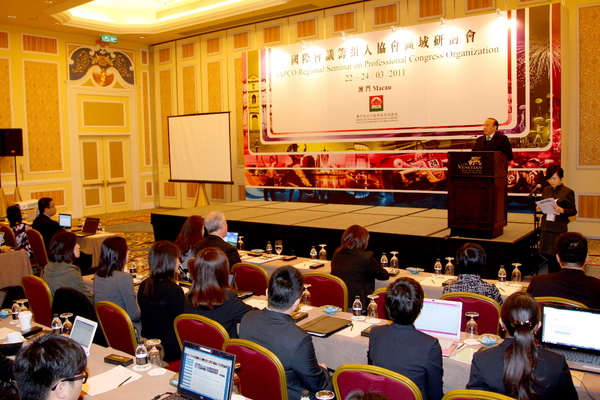
Organised by the International Association of Professional Congress Organizers (IAPCO) and hosted by the Macau Business Tourism Centre (MBTC) of Macau Government Tourist Office (MGTO), the "IAPCO Regional Seminar on Professional Congress Organization" opened today (March 22) at the Venetian Macau~Resort~Hotel. The regional seminar is set to run from 22 to 24 March, with around 40 MICE industry professionals from Macau and other regions in Asia participating. This is the third consecutive year for the prestigious IAPCO Regional Seminar to be held in Macau. The seminar aims to provide an educational opportunity for people in the business tourism industry to further develop their customer service and event planning skills and features internationally renowned guest speakers who are experts in the congress industry. Director of MGTO, João Manuel Costa Antunes, said in his opening remarks that “According to the Macau SAR Government 2011 policy address, the Government will fully support the development of the convention and exhibition industry. For this purpose, the Convention Industry Development Committee was set up last March to coordinate the development of this sector.” He pointed out that the organization of this training seminar is part of the efforts of the Macau SAR Government to support the training and development of the business tourism industry in Macau, which is one of the most promising sectors in the city. Statistics show that for the whole year of 2010 the number of MICE events saw a year-on-year increase of 15 percent to a total of around 1,400, with the majority of the events being meetings and conferences. Last year's MICE events saw the average duration increasing to 2.5 days from 2.0 days in 2009, while the number of participants reached more than 800 thousand, up by 41 percent year-on-year. Antunes noted that “There is certainly a lot of potential for the future development of this sector. However, to attract and service this sector well, we need to constantly upgrade our software, besides hardware and infrastructure improvements.” He acknowledged IAPCO for their assistance in developing the professional know-how for the sector in the region. Participants in the regional seminar included professional congress organisers (PCOs), destination management companies (DMCs), convention and visitors bureaus, event management companies and other meetings industry representatives from Macau SAR, Hong Kong SAR, Malaysia, the Philippines, and Taiwan, China and each participant will receive a certificate of attendance from IAPCO & MGTO.
…